
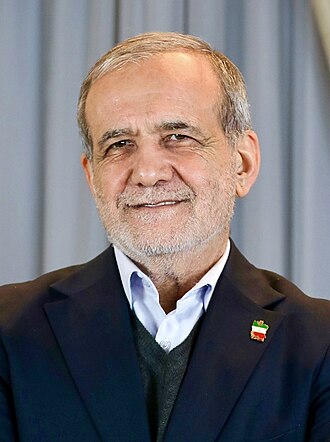
Masoud Pezeshkian

Iran
independent politician
President of Iran
government
Masoud Pezeshkian is an Iranian politician and heart surgeon who has served as the ninth president of Iran since 2024. A member of the reformist faction, he is the oldest person to serve in this position, taking office at the age of 69.
Standing...
Stories...
Aug 25, 2026
Far Left
Iranian president who admitted economic hardships but claimed the US failed to destabilize Iran, in a war with Washington.
His defiance is used by Morena-friendly media to highlight Trump's failed foreign adventures and counter US aggression.
Aug 25, 2026
Lean Right
President Pezeshkian stated that Iranians are more aware than ever of being deceived by criminal and deceptive enemies.
Conservatives would support his strong rhetoric against foreign enemies, reinforcing the narrative of national unity and resistance.
Aug 25, 2026
Lean Left
President reiterated that enemies seek to assassinate capable Iranian figures, and emphasized his government's independence from religious, ethnic, and gender biases in administration.
Moderates see Pezeshkian as trying to balance Reformist promises with theocratic constraints, but his statements are often symbolic without policy follow-through.
Aug 24, 2026
Center
A reformist MP publicly warned him against raising fuel prices, citing his successful handling of two wars as proof of his capacity.
Pragmatists are anxious about his economic management, fearing that a fuel price hike could trigger unrest and damage his reformist credibility.
Aug 23, 2026
Far Left
Iran's president said now is the time to end the war from a 'position of strength' against the US.
Morena sees this as a rational stance against US aggression, supporting Iran's right to self-defense and criticizing US policy.
Aug 23, 2026
Lean Left
President Pezeshkian defended the recent memorandum as 'dignified' and free of 'vadadagi' (concession), emphasizing alignment with the Supreme Leader's policies.
Moderates see Pezeshkian as a pragmatic centrist navigating between reformist hopes for de-escalation and hardline pressure, his defense of the memorandum aims to reassure the public of its strength.
Aug 23, 2026
Center
Said the war with the US should end because the world accepts Iran has won, while Tehran threatens states joining sanctions.
Renaissance analysts see this as a calculated mixed signal, requiring firm European sanctions enforcement and dialogue only from strength.
Aug 21, 2026
Far Left
As president, his administration's frustration with slow implementation of laws is highlighted by his executive deputy's comments, pointing to ongoing inefficiencies in the bureaucracy.
Reformists within the government are using this criticism to push for more effective governance and faster reforms, appealing to public dissatisfaction with the status quo.
Aug 21, 2026
Lean Left
Not directly cited, but his government's agenda is reflected in local news about state visits and development projects in Kurdistan.
Moderates expect him to deliver on his 'action and results' promise, particularly in underdeveloped provinces like Kurdistan.
Aug 20, 2026
Center
While not directly in these articles, Pezeshkian's administration is likely behind the current diplomatic push and economic messaging.
Pragmatists judge him by his ability to deliver on the reformist agenda within theocracy, a task made harder by hardline opposition and US sanctions.