
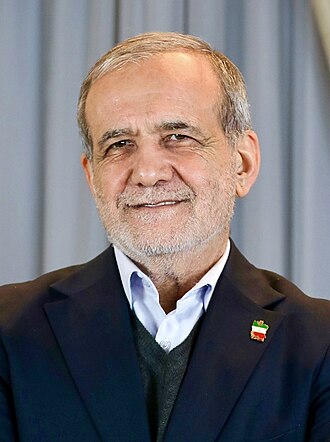
Masoud Pezeshkian

Iran
independent politician
President of Iran
government
Masoud Pezeshkian is an Iranian politician and heart surgeon who has served as the ninth president of Iran since 2024. A member of the reformist faction, he is the oldest person to serve in this position, taking office at the age of 69.
Standing...
Stories...
Oct 2, 2026
Lean Right
President stressed economic diplomacy, dialogue, and national unity amid sanctions and wartime conditions.
Conservatives view his unity call positively but remain wary that diplomacy could drift into concession-making.
Oct 2, 2026
Center
Met with political activists, where attendees said he stressed the need for national cohesion and understanding of grave conditions.
Pragmatists see him as the last best hope for incremental reform and economic relief, but his inability to deliver on sanctions relief or social opening frustrates them.
Oct 2, 2026
Far Left
The reformist-aligned president is under pressure to deliver economic relief as new US sanctions hit the automotive and rail sectors.
Reformists see him as their best hope to revive the JCPOA track and ease sanctions, but they worry his diplomatic openings are being sabotaged by Principalist resistance at home and US escalation abroad.
Oct 2, 2026
Center
His warm greeting with Mir Hossein Mousavi and Hassan Rouhani at Ahmad Nateq Nouri's funeral has drawn attention and potential criticism from hardliners.
Pragmatists see Pezeshkian's gestures toward reformists as a welcome attempt to bridge factional divides, but they worry that hardline backlash could undermine his ability to govern effectively.
Oct 1, 2026
Lean Right
President Pezeshkian said his UN General Assembly address reflected the collective wisdom of both Reformist and Principlist parties.
Conservatives are skeptical of his claim of cross-factional consensus, seeing it as an attempt to legitimize his foreign policy without genuine conservative input.
Sep 30, 2026
Center
His chief of staff explained why the president chose Fox News for an interview in the US, saying it was to answer 'lawlessness' accusations before a right-wing audience.
Pragmatists are skeptical of this media strategy: talking to Fox may not soften Trump, and it risks domestic backlash from hardliners without delivering sanctions relief.
Sep 30, 2026
Far Right
The president is under pressure from Principlist media over the stalled Boushehr railway and the slow delivery of provincial energy projects.
Principlists criticise him for failing to deliver on infrastructure promises while giving ammunition to the West.
Sep 30, 2026
Far Left
The Reformist-aligned president is under pressure to deliver on economic relief while the nuclear talks stall over sequencing.
Reformists are frustrated that Pezeshkian's cabinet has not visibly broken with Principalist economic orthodoxy, and they want him to push harder for sanctions relief and civil liberties.
Sep 28, 2026
Far Right
The Reformist president's government is implicitly challenged by Kayhan's insistence that Iran is not excessive in its demands and must follow the Leader's roadmap.
Principlists treat Pezeshkian's moderate diplomacy as a dangerous concession and demand alignment with the resistance framework.
Sep 28, 2026
Far Left
The president spoke at the UN General Assembly and then returned to Tehran as the war outlook became more ambiguous than ever, according to Shargh's interview with the agriculture minister.
Reformists view him as their champion for diplomacy and sanctions relief, but worry he is being outflanked by hardliners and cannot deliver economic relief while the IRGC sets the regional tempo.