
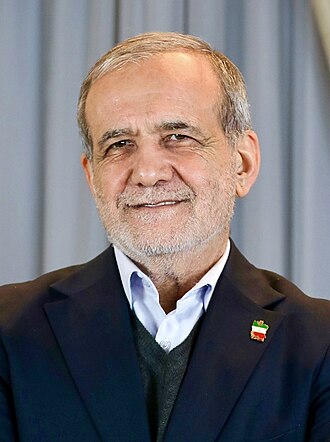
Masoud Pezeshkian

Iran
independent politician
President of Iran
government
Masoud Pezeshkian is an Iranian politician and heart surgeon who has served as the ninth president of Iran since 2024. A member of the reformist faction, he is the oldest person to serve in this position, taking office at the age of 69.
Standing...
Stories...
Aug 31, 2026
Far Right
Kayhan publishes a direct warning to him about infiltration in his government and notes his attack on IRIB drew Zionist and opposition glee.
Principlists view Pezeshkian's reformist tilt and media criticism as dangerous, risking the Islamic Republic's institutions and unity.
Aug 30, 2026
Far Right
President faces Kayhan criticism for appointing a 'terrorist and mob supporter' to his government again, and is accused of reviving 'Turkmanchai' logic via Qaem-Panah.
Principlists see Pezeshkian's moderation as appeasement, arguing his appointments and negotiating style risk concessions that weaken Iran's revolutionary stance.
Aug 30, 2026
Far Left
President emphasized Iran's unwillingness to start a war but vowed to stand strong against any aggressor, signaling a defensive posture.
Reformists see his stance as a rational effort to de-escalate tensions while maintaining national credibility, a welcome contrast to hardline rhetoric.
Aug 29, 2026
Center
In a televised address, he said continued sanctions will worsen inflation and that Iran will match any violation of commitments during talks.
Pragmatists see him as walking a fine line: acknowledging economic pain while trying to keep the negotiating path open, but his admission of inflation is double-edged.
Aug 28, 2026
Center
Though not directly in the articles, his government's budget strategy of relying on bond sales and cutting development spending is being analyzed in the context of the 500 trillion toman deficit.
Pragmatists are critical of this approach, fearing that short-term debt issuance will crowd out private investment and mortgage the country's future, while the administration avoids politically painful subsidy reforms.
Aug 27, 2026
Lean Left
Attended the memorial ceremony for the late statesmen, underscoring his role as the head of the reformist-backed government.
Moderates see him as a stabilizing figure within the theocratic system, but his administration is increasingly challenged by the ongoing conflict and economic pressures.
Aug 27, 2026
Center
President Pezeshkian emphasized that the government's approach is based on interaction and negotiation, and stressed the need for transparent and honest dialogue with the people on economic issues.
Pragmatists view his push for de-escalation and economic coherence as essential to managing the war and sanctions without alienating the public.
Aug 26, 2026
Lean Right
As president, his administration's record fuel reserve achievement and local project openings are being highlighted today.
Conservative readers are cautiously supportive, viewing his government's delivery on bread-and-butter issues as proof that moderate alignment with the Supreme Leader can yield results.
Aug 25, 2026
Center
The economic ministers' announcements on SME support and defensive rhetoric are part of Pezeshkian's government's broader strategy amid sanctions and war.
Pragmatists judge Pezeshkian's cabinet by whether their practical measures can shield ordinary Iranians from sanctions' impact, but doubt the efficacy of symbolic support packages.
Aug 25, 2026
Far Left
President emphasized serving people beyond factional views, but his statement is undercut by economic turmoil.
Reformists see his rhetoric as necessary but insufficient unless he confronts hardliners blocking economic reforms.