
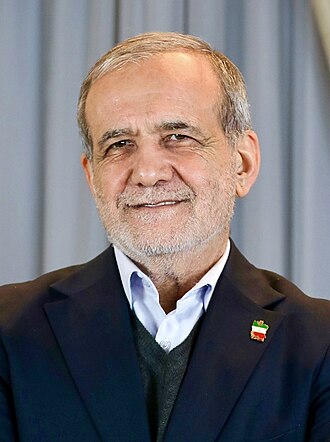
Masoud Pezeshkian

Iran
independent politician
President of Iran
government
Masoud Pezeshkian is an Iranian politician and heart surgeon who has served as the ninth president of Iran since 2024. A member of the reformist faction, he is the oldest person to serve in this position, taking office at the age of 69.
Standing...
Stories...
Aug 20, 2026
Far Left
President said on Wednesday that negotiation is not surrender, citing China's economic competition as a global example.
Reformists support Pezeshkian's diplomatic overtures as necessary to relieve sanctions, but they worry his message is being undermined by hardliners who equate any talks with capitulation.
Aug 19, 2026
Far Right
Reformist president, not mentioned directly, but Reformist positions are attacked in the context of the 'Liakhov' spirit article.
His administration's potential openness to talks is condemned as naive and dangerous, exposing the system to foreign infiltration.
Aug 19, 2026
Center
In a meeting with jihadi agriculture activists, he attacked slow bureaucracy and closed minds and called for administrative reform, low-water farming, and environmental care.
Pragmatists back his message that domestic institutional reform is essential to reduce import dependence and deliver on the government's economic pledges.
Aug 18, 2026
Lean Right
Pezeshkian pointed to the 1980-1988 Iran-Iraq War as proof that solidarity, hope and patience guarantee Iran's resilience under foreign pressure.
Conservatives back his anti-pressure rhetoric but remain alert to any Reformist tilt toward negotiation with the West.
Aug 18, 2026
Lean Left
He wrote on X that patience, solidarity and hope are key to Iran's endurance against mounting foreign pressure and threats.
Moderates welcome his calming tone but want concrete government action on purchasing power and basic goods, not just morale-building messages.
Aug 17, 2026
Lean Left
Wrote on X that patience, solidarity and hope, as shown by freed prisoners, are the key to standing against increasing external pressure on Iran.
Moderates rally around his unifying language, but expect concrete steps on the blockade and economy, not just symbolic commemorations.
Aug 17, 2026
Center
His administration is implicitly the target of the hardline media's preemptive strike against the Caspian Convention, which has not yet been sent to parliament.
Pragmatists are watching him closely to see if he will have the political capital to push the agreement through against hardline opposition, or if he will capitulate as previous governments did.
Aug 15, 2026
Center
He met party secretaries and recounted a seven-hour session with the Supreme Leader, insisting the ceasefire memorandum was signed with the armed forces' consent.
Pragmatists view him as the system's most credible voice for stability, yet he risks losing all credibility with his base if fuel chaos and war fatigue keep dominating the agenda.
Aug 15, 2026
Far Left
His diplomatic team met Chinese diplomats before US-Iran nuclear talks, reflecting Tehran's willingness to seek international support.
Seen as a leader turning to China for balance as Iran faces US pressure, reinforcing Beijing's role as a responsible mediator.
Aug 11, 2026
Center
Publicly recounted his seven-hour meeting with the Supreme Leader, relaying advice to preserve unity.
Pragmatists view this as a signal that reformist figures are being managed carefully inside a hardline-dominated security framework.