
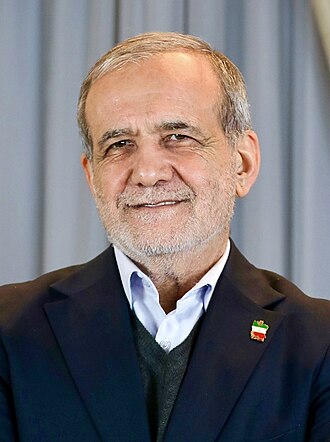
Masoud Pezeshkian

Iran
independent politician
President of Iran
government
Masoud Pezeshkian is an Iranian politician and heart surgeon who has served as the ninth president of Iran since 2024. A member of the reformist faction, he is the oldest person to serve in this position, taking office at the age of 69.
Standing...
Stories...
Sep 19, 2026
Far Left
Attended the 313,000-strong Janfadayan exercise among the crowd, shown in video released by Shargh.
Reformists view his presence at a mass mobilization event as an attempt to project national unity and firmness against external threats, but many in the Reformist camp worry he is being boxed into the Principalist security narrative rather than pushing for de-escalation and diplomacy.
Sep 18, 2026
Far Right
No direct mention in today's Kayhan items, but the president remains the central figure in the Reformist-Moderate government.
Principlists view Pezeshkian's administration with suspicion over its outreach to the West, seeing it as weak on the ideological boundaries set by the Supreme Leader.
Sep 18, 2026
Far Left
His legal deputy announced the government sent a letter to parliament detailing fundamental objections to the counter-infiltration bill.
Reformists support Pezeshkian's push to block a bill they fear will expand security crackdowns and further restrict political life.
Sep 16, 2026
Far Right
Not directly cited in today's articles, but as president he remains the focal point for economic management and diplomatic messaging.
Principalists remain skeptical of his reformist-aligned cabinet, watching for any deviation from resistance economy principles or concessions to the West.
Sep 16, 2026
Far Left
The Reformist-aligned president has remained largely silent on the hijab law letter and the regional escalation.
Reformists are frustrated by Pezeshkian's silence, seeing it as a missed opportunity to push back against the clerics and offer a diplomatic alternative.
Sep 15, 2026
Far Right
The President's diplomatic track, including the Muscat talks, is the target of Kayhan's warning that the negotiations are a trap.
Principlists suspect the reformist-backed president of offering concessions to Washington without securing tangible relief for the Iranian people.
Sep 15, 2026
Lean Left
The president's broader economic and social agenda is under pressure as power cuts, school shortages, and internet restrictions persist.
Moderates elected Pezeshkian expecting incremental relief, but his inability to deliver on electricity, education, or internet policy is testing their patience and making him look captive to forces outside his control.
Sep 14, 2026
Center
Not directly cited in articles, but the diplomatic push and dollar decline are attributed by analysts to his government's regional engagement strategy.
Pragmatists see him as the architect of the de-escalation that is bringing the dollar down, but they worry his team lacks follow-through on economic reforms.
Sep 14, 2026
Lean Right
President Pezeshkian publicly rejected US claims that Iran is pursuing nuclear weapons, stressing Iran's commitment to the NPT.
Conservatives view Pezeshkian's firm stance as a necessary defense of Iran's sovereignty, though some remain skeptical of his diplomatic outreach to the West.
Sep 14, 2026
Lean Left
The moderate president is not mentioned in the articles but his government faces pressure over economic policies and regional diplomacy.
Moderates are disappointed by his inability to curb judicial pressure on media, though they acknowledge his constrained room for maneuver.