
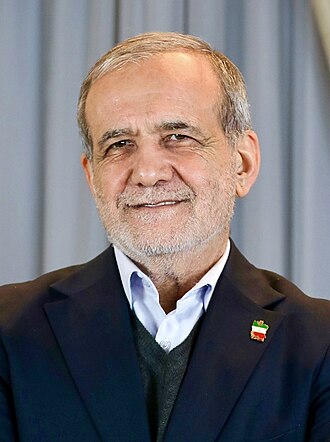
Masoud Pezeshkian

Iran
independent politician
President of Iran
government
Masoud Pezeshkian is an Iranian politician and heart surgeon who has served as the ninth president of Iran since 2024. A member of the reformist faction, he is the oldest person to serve in this position, taking office at the age of 69.
Standing...
Stories...
Sep 23, 2026
Far Left
The president is in New York for the UN General Assembly and is at the center of American and regional mediation efforts to end the war.
Reformists see Pezeshkian as the only figure capable of converting military escalation into a diplomatic off-ramp, and they want him to return with a ceasefire and sanctions relief rather than symbolic speeches.
Sep 22, 2026
Lean Left
President Pezeshkian chaired a meeting where the general outlines of a plan to increase food subsidy credits were approved, and ordered a review of tax exemptions for large profitable firms to fund it.
Moderates see this as a rare concrete step toward economic justice, but worry the plan lacks a credible funding mechanism and may be diluted by conservative resistance in the Majlis.
Sep 22, 2026
Far Left
As president, he faces scrutiny over the government's handling of the kala-berge subsidy and economic transparency.
Reformists are watching to see if Pezeshkian can deliver on transparency promises amid parliamentary criticism.
Sep 22, 2026
Far Right
Iran's president said Tehran does not want war but will not bow to pressure, as Trump weighs military action over the Strait of Hormuz closure.
Religious Zionism views Pezeshkian as a regime frontman whose words are meaningless while Iran pursues nuclear weapons and funds terror proxies, and sees his threats as proof that only military force will deter Tehran.
Sep 21, 2026
Center
As president, he is the implicit subject of Mahsouli's endorsement and the target of criticism over his executive deputy's energy-price proposal.
Pragmatists view Pezeshkian as caught between reformist expectations and principalist pressure, with his economic team's shock-therapy flirtation undermining his moderate mandate.
Sep 20, 2026
Far Right
The President's award to Shamkhani's widow is covered, but Kayhan's broader tone suggests suspicion of his moderate cabinet.
Principlists are skeptical of Pezeshkian, viewing his moderate rhetoric as a cover for eventual concessions to the West, and today's coverage implicitly warns him against deviating from resistance doctrine.
Sep 20, 2026
Lean Left
The president is the moderate standard bearer whose government is under pressure from hardliners over any return to talks with Washington.
Moderates are frustrated that his diplomatic agenda keeps getting subordinated to security establishment conditions, leaving him with little room to deliver sanctions relief.
Sep 20, 2026
Far Left
The president's executive deputy is cited in Shargh Daily's critique of the energy subsidy reform, defending the plan while the newspaper questions the gap between announced figures and household purchasing power.
Reformists are frustrated that Pezeshkian's economic team is pushing subsidy reform without a credible compensation mechanism, which hands Principalists an easy populist talking point.
Sep 19, 2026
Far Right
No direct mention, but his government's economic management is under implicit scrutiny in coverage of steel and schools.
Principlists are wary of Pezeshkian's moderate cabinet, urging adherence to revolutionary economic principles.
Sep 19, 2026
Lean Left
The president said unity and cohesion in all matters will disappoint the enemy.
Moderates hear a standard rally-round-the-flag message that avoids addressing the economic pain and regional war costs that are the real source of public anxiety.