
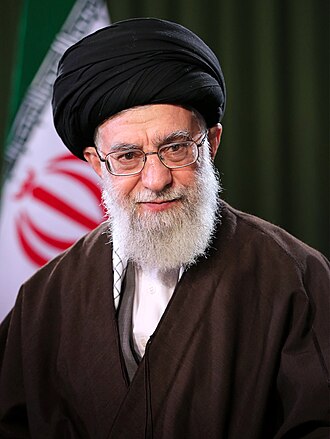
Ali Khamenei

other
Ali Hosseini Khamenei was an Iranian politician and Shia cleric who served as the second supreme leader of Iran from 1989 until his assassination in the 2026 Iran war. A member of the Khamenei family, he previously served as the third president of Iran from 1981 to 1989. He held the title Grand Ayatollah, and his tenure as supreme leader, spanning 36 years and six months, made him the longest-serving head of state in West Asia at the time of his death.
Standing...
Stories...
Jul 22, 2026
Far Right
His doctrine of resistance invoked in articles like 'People of Iran will take revenge' (article 17).
Principlists view him as supreme guide ensuring Iran's defiance against enemies.
Jul 21, 2026
Lean Left
The Supreme Leader remains the ultimate authority guiding foreign policy and nuclear negotiations, though not directly quoted in today's articles.
Moderates respect his role as the final arbiter but are wary of hardline constraints that limit diplomatic openings with the West.
Jul 21, 2026
Far Right
The million-strong funeral in Iraq demonstrated the deep connection between the Iraqi people and the Supreme Leader's leadership, as covered by Kayhan.
For Principlists, this event confirms the transnational appeal of the Leader's Islamic revolutionary ideology and the failure of US attempts to isolate Iran.
Jul 19, 2026
Far Right
The Supreme Leader is implicitly invoked through articles on martyrdom as a revolutionary necessity and the social capital of leadership.
Khamenei is the ultimate authority for principlists; his guidance is credited with Iran's strategic wins in Hormuz and the failure of the southern corridor.
Jul 19, 2026
Lean Right
Supreme Leader of the Islamic Revolution, the focal point of 140 consecutive nights of public demonstrations supporting Velayat-e Faqih.
Revered as the unifying symbol of the nation's resilience and the ultimate authority guiding resistance against foreign aggression.
Jul 19, 2026
Center
The Supreme Leader's recent message framing revenge as the 'will of the nation' has turned into a central theme in official discourse and public rallies.
Pragmatists critique this hardline narrative for constraining policy space and fueling domestic instability while providing no clear off-ramp.
Jul 19, 2026
Far Left
Delivered a statement tying Arbaeen pilgrimage to the funeral of a 'great martyr', likely a senior IRGC commander killed in the war.
Reformists see this as an attempt to frame the war in religious terms, but criticize the lack of accountability for the conflict's origins.
Jul 19, 2026
Far Right
Iran's Supreme Leader faces continued US airstrikes targeting military capabilities.
His regime is blamed for attacks on US troops and support for proxies; strikes are welcomed.
Jul 19, 2026
Lean Left
Warned of retaliation against US attacks and called Trump's signature 'worthless'.
Liberals see his hardline rhetoric as a dangerous escalation that complicates nuclear negotiations.
Jul 17, 2026
Lean Right
The Supreme Leader's advisor represented him at the martyr's home visit, underscoring the Leader's continued attention to IRGC families.
For conservatives, Khamenei is the ultimate authority and his indirect presence in this news reinforces the regime's ideological foundation.