
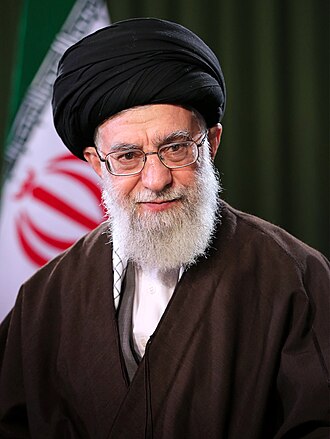
Ali Khamenei

other
Ali Hosseini Khamenei was an Iranian politician and Shia cleric who served as the second supreme leader of Iran from 1989 until his assassination in the 2026 Iran war. A member of the Khamenei family, he previously served as the third president of Iran from 1981 to 1989. He held the title Grand Ayatollah, and his tenure as supreme leader, spanning 36 years and six months, made him the longest-serving head of state in West Asia at the time of his death.
Standing...
Stories...
Aug 17, 2026
Center
Iran and the US appeared at a standstill in negotiations ahead of the Monday expiration of their ceasefire agreement.
Moderates view Khamenei as the key obstacle to a negotiated outcome that avoids a wider war and further gas price spikes.
Aug 16, 2026
Far Left
Iran faces US vows to cripple the economy while ships in Hormuz come under attack, raising war tensions.
The far left sees Khamenei as a brutal authoritarian but still opposes US sanctions and military threats as imperial aggression.
Aug 15, 2026
Center
The Supreme Leader sits behind the reported seven-hour meeting with Pezeshkian and remains the ultimate authority on whether any truce or negotiated settlement survives.
Pragmatists know that without his explicit and public backing for a deal, any diplomatic opening can be vetoed by the Guardian Council and the IRGC-aligned factions.
Aug 12, 2026
Center
Receives Rezaei's letter and a new religious ruling on halal and haram trade, while his security council appointee is reshaping policy.
Pragmatists view Khamenei as the ultimate arbiter whose hardline security choices override any pragmatic economic or diplomatic opening.
Aug 12, 2026
Far Left
Khamenei's Iran is at the center of Trump's demand for reparations and the dimming hopes for a Hormuz deal.
The far left rejects the framing of Iran as an aggressor and sees Trump's reparations demand as a pretext for economic warfare and continued US aggression in the Gulf.
Aug 12, 2026
Lean Right
Iran's supreme leader whose forces attacked US bases, raising worries that the same escalation could hit American bases in the Indo-Pacific.
Market liberals condemn the regime's aggression and insist US responses must restore deterrence without expanding a Middle East war.
Aug 12, 2026
Lean Right
Iran's supreme leader is in the news as Tehran reportedly links the Strait of Hormuz reopening to US concessions while also threatening Trump's travel.
Lean Right treats Khamenei's regime as the central threat and sees any concession as appeasement that rewards hostage diplomacy.
Aug 10, 2026
Far Left
The Supreme Leader appointed Mohsen Rezaei as secretary of the Supreme National Security Council and his own representative to the council.
Reformists read this as direct intervention to keep security policy in Principalist hands, weakening the moderate government's control over war and diplomacy.
Aug 9, 2026
Far Right
During a meeting with top commanders, he repeated that Iranian officials should not equate negotiation with 'red lines surrender,' and warned that some in the cabinet are 'naive about the enemy.'
Principlists treat his speech as the definitive verdict against the government's diplomacy, and they use his words to attack any talk of limiting enrichment or missile tests.
Aug 7, 2026
Lean Right
The 159-night protests across cities like Tabriz, Urmia, and Karaj are explicitly renewing the pledge of allegiance with him and supporting the armed forces.
For conservatives, he is the axis of national unity and the target of the martyred leader's revenge narrative, and these vigils validate his leadership against internal and external critics.