
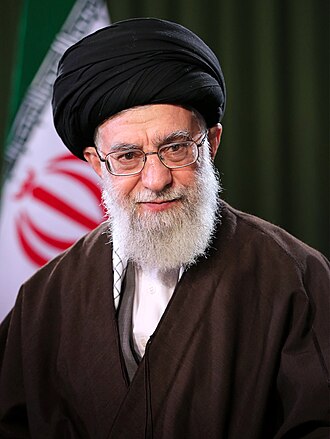
Ali Khamenei

other
Ali Hosseini Khamenei was an Iranian politician and Shia cleric who served as the second supreme leader of Iran from 1989 until his assassination in the 2026 Iran war. A member of the Khamenei family, he previously served as the third president of Iran from 1981 to 1989. He held the title Grand Ayatollah, and his tenure as supreme leader, spanning 36 years and six months, made him the longest-serving head of state in West Asia at the time of his death.
Standing...
Stories...
Aug 7, 2026
Far Right
Iran's supreme leader stands behind the IRGC threat plans and the Houthi attack that wounded civilians in Saudi Arabia.
Religious Zionism identifies Khamenei as the true command of the Iran axis, and therefore holds that peace will come only when his regime is deterred or defeated, not through a weak nuclear deal.
Aug 6, 2026
Center
The Supreme Leader looms over the fallout from Kharrazi's leaked remarks about his son and the alleged plot to topple the Pezeshkian government.
Pragmatists see him as the only actor able to discipline the hardline fringe, but fear his succession-oriented maneuvering will sacrifice the moderates to preserve the regime.
Aug 6, 2026
Far Right
His office denied a claim about his reaction to the president's letter, placing him at the center of political-military coordination.
Principlists see him as the absolute arbiter whose guidance keeps the government and military unified against external pressure and reformist drift.
Aug 6, 2026
Lean Right
The Supreme Leader anchors the strategic doctrine behind today's resistance posture, from fuel resilience to the Yemen and Lebanon fronts, though he is not directly named in these dispatches.
For conservatives, his red lines define the framework within which Araqchi negotiates and the military responds, and any deviation from his guidance is treated as the cardinal political sin.
Aug 6, 2026
Far Left
Ayatollah Khamenei publicly endorsed the hijab law and rejected any interference in the nuclear right at Qom Friday sermon.
Reformists consider his red lines the root cause of the nuclear deadlock and the collapse of civic peace, and they are convinced that the president cannot change course without his approval.
Aug 5, 2026
Far Left
The Supreme Leader endorsed the new hijab law and reaffirmed that security forces must not retreat in the face of protests.
Reformists view his red lines as the true obstacle to any political opening, and they blame him for preserving Guardian Council vetting and morality police enforcement.
Aug 4, 2026
Far Right
Kayhan's resistance discourse revolves around the Supreme Leader's guidance, with editorials arguing that Iran's defiant stance is now turning the heat back on America.
Principlists present his leadership as the source of strategic steadiness that allowed Iran to resist US pressure without yielding to reformist calls for concession.
Aug 4, 2026
Center
Iran's leadership denies Trump's claim that new talks begin Monday while negotiating with Oman over the Strait of Hormuz.
Centrists want diplomatic off-ramps with Iran but are skeptical of trusting Tehran's assurances.
Aug 3, 2026
Far Right
The Supreme Leader's recent speeches on foreign dignity and internal discipline are being cited by both factions in the nuclear and hijab disputes.
Principlists view his red lines and 'resistance economy' orders as the binding authority that Pezeshkian's cabinet is failing to obey.
Aug 3, 2026
Lean Right
Iran under his authority is threatening to close the Strait of Hormuz and other strategic choke points.
Conservative readers view Khamenei's regime as the central driver of global terrorism and instability.