
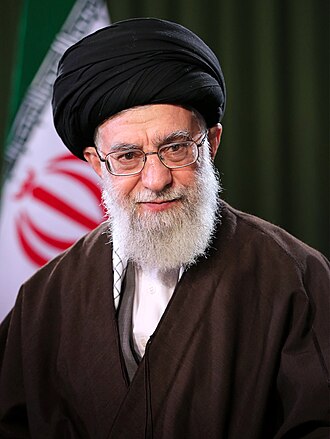
Ali Khamenei

other
Ali Hosseini Khamenei was an Iranian politician and Shia cleric who served as the second supreme leader of Iran from 1989 until his assassination in the 2026 Iran war. A member of the Khamenei family, he previously served as the third president of Iran from 1981 to 1989. He held the title Grand Ayatollah, and his tenure as supreme leader, spanning 36 years and six months, made him the longest-serving head of state in West Asia at the time of his death.
Standing...
Stories...
Jun 15, 2026
Far Right
Supreme Leader delivered a speech rejecting any compromise with the US on nuclear program and regional influence.
Praised for upholding revolutionary principles and resisting Western demands, reinforcing the Supreme Leader's role as the ultimate arbiter of national policy.
Jun 15, 2026
Far Right
The Supreme Leader recently delivered key directives on economic resistance and national unity, emphasizing the importance of internal strength.
Principlists view his guidance as the paramount ideological and strategic framework, essential for navigating complex domestic and international challenges with revolutionary steadfastness.
Jun 12, 2026
Far Right
Supreme Leader Khamenei has issued renewed public statements on the conditions and red lines for any nuclear engagement, framing the talks within a resistance ideology.
Principlists cite Khamenei as the essential anchor preventing the Pezeshkian government from drifting too far toward Western terms, and his statements are used to pressure negotiators to hold firm.
Jun 12, 2026
Far Right
Iran's Supreme Leader is reported by Trump to have approved the US-Iran framework, while Iranian forces simultaneously conducted military operations near Bandar Abbas and the Strait of Hormuz.
Religious Zionism sees Khamenei's simultaneous deal approval and military posturing as confirmation that Iran is negotiating in bad faith while consolidating strategic leverage in the Hormuz corridor.
Jun 11, 2026
Far Right
Khamenei has publicly reiterated that Iran will not abandon uranium enrichment as a core national right, directly shaping the negotiating posture of the Pezeshkian government in ongoing indirect talks with the United States.
Principalists view Khamenei's firm red lines as essential protection against a repeat of the JCPOA era, when they believe reformist-aligned diplomats traded away strategic leverage for fragile and ultimately broken Western promises.
Jun 11, 2026
Far Right
Iran's Supreme Leader presides over a military now actively engaging US forces at sea and in the air, with the IRGC closing the Strait of Hormuz and claiming missile fire at an American F-16.
Religious Zionism sees Khamenei as the existential threat driving this crisis, and his regime's direct confrontation with the US confirms the movement's longstanding argument that deterrence without force was always insufficient.
Jun 11, 2026
Lean Right
Citizens across dozens of Iranian cities held their 102nd consecutive night of public gatherings pledging loyalty to the Supreme Leader as U.S. strikes hit Iranian territory.
From the Conservative perspective, Khamenei's leadership is seen as the anchor of national resistance, with mass nightly rallies framed as organic popular support for his command during wartime.
Jun 10, 2026
Lean Right
Citizens across dozens of Iranian cities, from Mashhad to Sanandaj to Qom, held their 101st consecutive night of public rallies renewing pledges of loyalty to the Supreme Leader.
Conservatives present the mass biat (pledge of allegiance) gatherings as organic proof that the Islamic Republic's social contract is holding under military pressure, vindicating Khamenei's resistance doctrine.
Jun 9, 2026
Far Right
Khamenei has issued statements reaffirming non-negotiable red lines in nuclear talks and reminding negotiators of the limits of acceptable compromise with Western powers.
Principlists view Khamenei as the essential bulwark against diplomatic capitulation, citing his consistent framing of negotiations as a defensive necessity rather than an ideological retreat.
Jun 8, 2026
Far Right
The Supreme Leader has issued fresh guidance emphasizing economic resistance and self-sufficiency as the correct response to Western sanctions, framing dependence on negotiations as strategically dangerous.
Principlists cite Khamenei's statements as authoritative validation of their opposition to the Pezeshkian team's outreach diplomacy, arguing the Leader's line must override any reformist-leaning foreign policy impulse.