
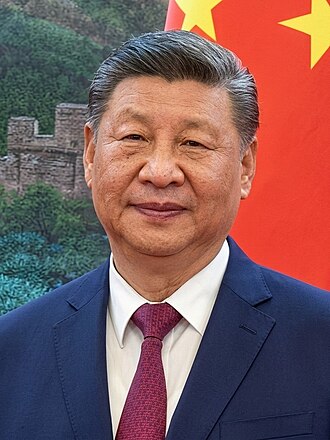
Xi Jinping

other
Xi Jinping is a Chinese statesman and politician who has served as the general secretary of the Chinese Communist Party (CCP) and chairman of the Party Central Military Commission (CMC) since 2012, and the president of China and chairman of the State Central Military Commission since 2013. Xi has been the leader of the fifth generation of Chinese leadership since 2012.
Standing...
Stories...
Aug 15, 2026
Far Left
Reaffirmed Taiwan as the 'core of core interests' in a call with Trump, with experts saying space for 'relying on US for independence' is shrinking.
Praised as the leader who protects national sovereignty and manages great-power relations without conceding on China's bottom-line interests.
Aug 15, 2026
Far Right
The leader behind the censorship regime that blocks keywords and the political-legal system prosecuting Jing Shuren.
Pro-reform critics hold him responsible for the twin crackdowns on speech and labor, arguing his stability-first doctrine is strangling civic life.
Aug 15, 2026
Lean Left
Xi held a phone call with Trump and held talks with Serbian President Nikolic, anchoring China's big-power diplomacy.
CCP mainstream praises Xi as the core leader who keeps China confident in managing China-US relations and expanding Belt and Road influence.
Aug 13, 2026
Far Right
He leads the party-state whose policies and legal system put Jing Shuren on trial and continue Zhu Rongji's Tibetan development approach.
Pro-reform observers see him as the central obstacle to liberalization, defending censorship, detention, and control over minority regions.
Aug 13, 2026
Center
Xi is preparing for summit talks with Trump in Washington next month while China projects outward confidence despite economic anxiety.
Pragmatists evaluate Xi on whether the summit delivers concrete bilateral results such as the stalled Board of Investment, not on official messaging.
Aug 13, 2026
Lean Left
Xi held phone talks with U.S. President Donald Trump and hosted Serbian President Tomislav Nikolic, reinforcing China's major-power diplomacy.
The CCP mainstream sees Xi as the strategic core whose personal diplomacy keeps China's relations with Washington stable and expands Belt and Road partnerships.
Aug 13, 2026
Far Left
Xi's global development initiatives are analyzed by Enrique Dussel Peters as central to a new Chinese-led globalization.
Morena's left sees Xi as a counterweight to US hegemony and a potential partner for Mexican development, though it must be managed carefully.
Aug 13, 2026
Far Left
Xi's secretive graft purges have spawned an underground market for leaks about who might be purged next.
The far left's internal split on China is visible here, but many see Xi's opaque authoritarian crackdown as proof that capitalist Communist Party rule reproduces repression.
Aug 12, 2026
Lean Left
Xi spoke with Trump by phone about ties and the Korean Peninsula and held talks with Serbian President Tomislav Nikolic on Belt and Road cooperation.
For CCP mainstream outlets, Xi is the anchor of a confident foreign policy that manages U.S. differences while expanding China's global partnerships.
Aug 12, 2026
Lean Right
Chinese leader presiding over senior PLA leadership changes that could give the Air Force greater presence on the Central Military Commission.
Market liberals view his military consolidation as a threat to the regional balance of power and to Taiwan's security.