
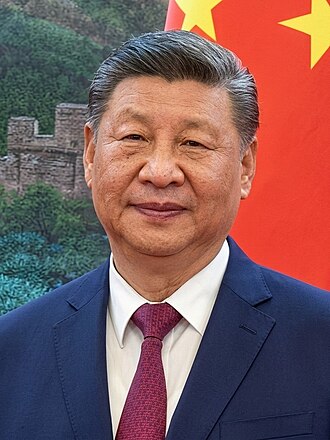
Xi Jinping

other
Xi Jinping is a Chinese statesman and politician who has served as the general secretary of the Chinese Communist Party (CCP) and chairman of the Party Central Military Commission (CMC) since 2012, and the president of China and chairman of the State Central Military Commission since 2013. Xi has been the leader of the fifth generation of Chinese leadership since 2012.
Standing...
Stories...
Aug 18, 2026
Lean Left
Held phone talks with Trump and met Serbian President Nikolic, pledging cooperation and discussion of Korean Peninsula and Belt and Road.
Praised as the strategist steering superpower relations and advancing Belt and Road, embodying CCP mainstream confidence in strong leadership.
Aug 17, 2026
Far Right
Xi Jinping's rule is the structural context for the censorship, labor prosecution, and ethnic repression highlighted in this week's articles.
Pro-reform critics hold Xi personally responsible for intensifying CCP control and see every story about blocked words or detained workers as evidence of that tightening.
Aug 17, 2026
Center
A party research group invoked Jiang Zemin's legacy in the People's Daily to rally everyone around Xi's leadership.
Pragmatists see Xi using Jiang's centenary to shore up internal cohesion, particularly as the party manages reform-era history and succession expectations.
Aug 17, 2026
Lean Left
He held phone talks with Trump and hosted Serbian President Nikolic, discussing Korea, bilateral ties, and Belt and Road cooperation.
CCP Mainstream praise centers on his steady handling of US ties and his Belt and Road leadership, reinforcing China's status as a responsible great power.
Aug 16, 2026
Far Right
Xi Jinping presides over a week in which the state celebrates Fields Medal winners while courts try a migrant worker for reposting and censors keyword speech.
Pro-reform audiences see this contrast as proof that the CCP uses nationalist achievements to mask tightening political repression.
Aug 16, 2026
Lean Left
He held phone calls and talks with U.S. President Donald Trump and Serbian President Tomislav Nikolic, while also overseeing Belt and Road outreach.
Praised as the core leader whose personal diplomacy strengthens China's global standing and manages major power relations without conceding on core interests.
Aug 15, 2026
Far Left
Reaffirmed Taiwan as the 'core of core interests' in a call with Trump, with experts saying space for 'relying on US for independence' is shrinking.
Praised as the leader who protects national sovereignty and manages great-power relations without conceding on China's bottom-line interests.
Aug 15, 2026
Far Right
The leader behind the censorship regime that blocks keywords and the political-legal system prosecuting Jing Shuren.
Pro-reform critics hold him responsible for the twin crackdowns on speech and labor, arguing his stability-first doctrine is strangling civic life.
Aug 15, 2026
Lean Left
Xi held a phone call with Trump and held talks with Serbian President Nikolic, anchoring China's big-power diplomacy.
CCP mainstream praises Xi as the core leader who keeps China confident in managing China-US relations and expanding Belt and Road influence.
Aug 13, 2026
Far Right
He leads the party-state whose policies and legal system put Jing Shuren on trial and continue Zhu Rongji's Tibetan development approach.
Pro-reform observers see him as the central obstacle to liberalization, defending censorship, detention, and control over minority regions.