
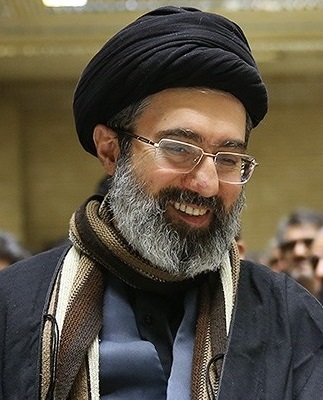
Mojtaba Khamenei

Mojtaba Hosseini Khamenei is an Iranian politician and Shia cleric who has served as the Deputy Chief of Staff of the Office of the Supreme Leader of Iran for Political and Security Affairs since 1997. A member of the Khamenei family and the second eldest child of Ali Khamenei, the former supreme leader, he served in the Iran–Iraq War from 1987 to 1988, and also reportedly took control of the Basij that was used to suppress the protests over the 2009 presidential election.
Standing...
Stories...
Jul 19, 2026
Far Right
The Iranian Supreme Leader threatened 'unforgettable lessons' for the US and accused America of violating agreements after renewed strikes.
RN views Khamenei as the head of a dangerous theocracy that must be confronted militarily, and his threats justify a firm allied response.
Jul 19, 2026
Lean Left
Issues a warning to Trump after two US service members are killed in Iran-US conflict.
Labour is concerned about escalation and criticizes the Trump administration's reckless approach.
Jul 12, 2026
Lean Right
Promised to avenge his father Ali Khamenei's assassination.
LR sees him as a dangerous hardliner, reinforcing the need for a firm Western stance against Iran.
Jul 12, 2026
Center
After missing his father's funeral, the new Supreme Leader issued written threats of revenge against Israel, but remains unseen in public due to reported injuries.
Yesh Atid views his hidden condition and written threats as a sign of Iranian regime weakness and internal chaos, but warns that the revenge threat is real and must be taken seriously.
Jul 11, 2026
Center
Iran's new Supreme Leader has not appeared in public since being wounded in strikes that killed his father, raising questions about his role.
Viewed with concern as a weakened leader potentially destabilizing Iran further, requiring firm Western response.
Jul 11, 2026
Center
After absent from his father's funeral, the new Supreme Leader issued a written threat vowing revenge against Israel, raising concerns about his health and regime stability.
Yesh Atid sees his opaque leadership and vow of revenge as a clear sign that Iran remains an existential threat, requiring firm Israeli deterrence and diplomatic pressure, not the current government's mixed signals.
Jul 10, 2026
Center
New Supreme Leader of Iran, absent from his father's funeral after being wounded in US-Israeli strikes.
Renaissance analysts see his absence as a sign of Iran's leadership instability and a risk to regional stability.
Jul 10, 2026
Center
Mojtaba Khamenei has succeeded his father as Supreme Leader of Iran amid ongoing conflict with the US.
Renaissance is wary of the new leader's hardline credentials and calls for European mediation to prevent escalation.
Jul 9, 2026
Center
Succeeds his father as Supreme Leader of Iran amid ongoing strikes and uncertainty over the regime's direction.
Viewed with deep suspicion as a continuation of theocratic hardline rule; Renaissance worries his leadership will perpetuate conflict with the West.
Jul 7, 2026
Far Right
Unofficial reports claim he was spotted at his father's funeral, sparking speculation about Iran's leadership transition.
His potential rise to Supreme Leader is a critical security issue; Religious Zionism views any change in Iran with caution and readiness.