
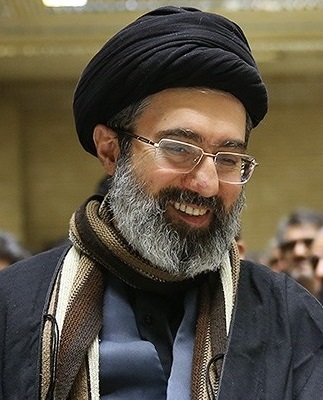
Mojtaba Khamenei

Mojtaba Hosseini Khamenei is an Iranian politician and Shia cleric who has served as the Deputy Chief of Staff of the Office of the Supreme Leader of Iran for Political and Security Affairs since 1997. A member of the Khamenei family and the second eldest child of Ali Khamenei, the former supreme leader, he served in the Iran–Iraq War from 1987 to 1988, and also reportedly took control of the Basij that was used to suppress the protests over the 2009 presidential election.
Standing...
Stories...
Sep 27, 2026
Far Right
Iran's Supreme Leader validated a plan to reopen the Strait of Hormuz within seven days.
RN sees this as another example of Iran exploiting global tensions, and criticizes Macron's weak diplomacy that fails to protect French energy interests.
Sep 15, 2026
Far Right
A report exposed a power struggle at the top of Iran's regime amid questions about who is actually wielding authority in the absence of the unseen Supreme Leader.
The reported vacuum is relevant because this cohort wants to know whether escalation with Iran is being driven by a coherent state or by hardline factions maneuvering in the dark, which shapes how they judge any US military response.
Aug 30, 2026
Far Right
Iran's Supreme Leader called for unity as US economic pressure intensifies, with new sanctions on an Egyptian bank.
Khamenei's call for unity is a sign of weakness; Religious Zionism views the Iranian regime as a mortal threat that must be countered with maximum pressure, not appeasement.
Aug 30, 2026
Center
Khamenei's son is consolidating a hardline core in Iran, surrounding himself with loyalists who suppress protests.
Yesh Atid sees the rise of hardliners in Iran as a security threat, urging Israel to prepare for prolonged confrontation.
Aug 10, 2026
Lean Right
The Iranian supreme guide holds a rare meeting with the president amid negotiations over Hormuz and mounting domestic repression.
LR regards Khamenei's consolidation of power as proof that the Islamic Republic remains a theocratic police state, making any negotiated deal with it inherently fragile.
Aug 6, 2026
Center
Kharrazi's remarks mention him as a hardline figure with much harsher views than the martyred leader, implying succession and power struggles inside the Supreme Leader's inner circle.
Pragmatists worry that power brokers around him are pushing a destabilizing line that worsens factional conflict and complicates any possible detente with the West.
Aug 3, 2026
Center
Iran's hidden new supreme leader has issued no public appearance for months, leaving real power unclear.
Yesh Atid sees an opaque Iran as a threat that requires Israel to maintain independent deterrence, especially while the US sends mixed signals.
Jul 25, 2026
Center
US intelligence assesses he seeks a nuclear warhead that can be mounted on a long-range missile, a departure from his father's stance, prompting Iran to reinforce underground facilities.
His hardline ambition is viewed as an existential threat; Yesh Atid demands a clear Israeli strategy backed by international pressure, not just military posturing.
Jul 20, 2026
Lean Right
Iran's supreme leader warned of 'unforgettable lessons' if the U.S. continues attacks after the drone and missile strike on a base in Jordan.
Lean Right sees him as an implacable enemy whose threats underscore the need for a decisive military response and stronger deterrence.
Jul 19, 2026
Center
Called the US 'the Great Satan' and threatened an 'unforgettable lesson' after American deaths in Jordan.
Reflects the Iranian threat that Yesh Atid warns requires a responsible government, not a distracted one.