
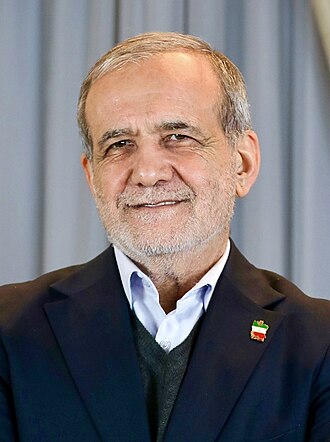
Masoud Pezeshkian

Iran
independent politician
President of Iran
government
Masoud Pezeshkian is an Iranian politician and heart surgeon who has served as the ninth president of Iran since 2024. A member of the reformist faction, he is the oldest person to serve in this position, taking office at the age of 69.
Standing...
Stories...
Jun 15, 2026
Far Left
President Pezeshkian thanked the Supreme Leader and promised that details of the agreement will be shared at the appropriate time.
Reformists see Pezeshkian as a cautious centrist who must balance the Supreme Leader's approval with public demands for transparency and civilian-led rebuilding.
Jun 12, 2026
Far Right
President Pezeshkian is dominating coverage due to his administration's pursuit of indirect nuclear diplomacy with the United States via Omani mediation and his conciliatory tone toward European capitals.
Principlists view Pezeshkian as dangerously naive or deliberately accommodationist, fearing his team will repeat Rouhani-era mistakes by offering nuclear concessions without receiving durable, verified sanctions relief in return.
Jun 11, 2026
Far Right
President Pezeshkian has authorized a diplomatic track with Oman as intermediary for indirect U.S.-Iran nuclear talks, raising questions about how far his government will go in meeting American demands.
Principalists are deeply skeptical of Pezeshkian, watching his every diplomatic move for signs that his reformist-leaning cabinet is preparing concessions on enrichment levels or ballistic missiles that would undermine Iran's deterrence posture.
Jun 10, 2026
Far Left
President Pezeshkian publicly stated that the 'neither war nor peace' situation is unsustainable and must be resolved, signaling urgency around the nuclear negotiation track.
Reformists broadly support Pezeshkian's push for a diplomatic resolution, seeing his statement as a rare honest acknowledgment of Iran's deteriorating strategic position and a call to break the hardline deadlock.
Jun 10, 2026
Lean Left
President Pezeshkian appeared via video conference at the inauguration of the Ardabil railway and a five-star Ardabil-Mashhad train line on the same night US strikes hit southern Iran.
Moderates who backed Pezeshkian for his reformist-adjacent pragmatism are watching closely to see whether his government can assert control over the crisis narrative or whether hardliners and the IRGC will dominate the response.
Jun 9, 2026
Far Right
Pezeshkian's administration is actively pursuing indirect dialogue with the United States through Omani mediation and has signaled openness to confidence-building measures on uranium enrichment caps.
Principlists are deeply suspicious of Pezeshkian's reformist political base and fear his negotiating team will trade away strategic enrichment achievements for sanctions relief that the West can reverse at will.
Jun 8, 2026
Far Right
President Pezeshkian is navigating intense factional pressure as he attempts to balance reformist-leaning domestic promises with Principlist-dominated institutions and ongoing nuclear diplomacy.
Principlists view Pezeshkian with deep suspicion, arguing his reformist allies are using economic grievances as cover to push ideological concessions that undermine the Islamic Republic's foundational resistance posture.
Jun 8, 2026
Center
Pezeshkian's son publicly defended his father against accusations that the administration mishandled war-driven inflation, arguing military realities, not policy failures, are causing economic pain.
Pragmatists see Pezeshkian in an impossible bind: he must support the military response to retain legitimacy while absorbing blame for economic deterioration that the conflict is directly accelerating.
Jun 7, 2026
Far Left
Pezeshkian chaired an economic coordination council and issued direct orders to increase the credit value of food vouchers for low-income households.
Reformists view this as a meaningful but insufficient welfare measure, praising the intent while noting it papers over deeper structural failures that the administration lacks full authority to fix.
Jun 7, 2026
Far Right
President Pezeshkian's administration is actively pursuing indirect nuclear talks with the United States, with his foreign policy team engaging Omani and European intermediaries.
Principlist media frames Pezeshkian as dangerously deferential to reformist foreign policy instincts, warning that his negotiating posture risks legitimizing American pressure without extracting binding relief from sanctions.