
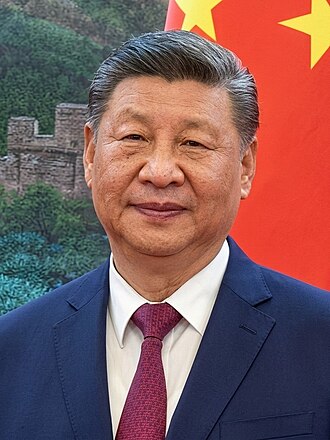
Xi Jinping

other
Xi Jinping is a Chinese statesman and politician who has served as the general secretary of the Chinese Communist Party (CCP) and chairman of the Party Central Military Commission (CMC) since 2012, and the president of China and chairman of the State Central Military Commission since 2013. Xi has been the leader of the fifth generation of Chinese leadership since 2012.
Standing...
Stories...
Jun 6, 2026
Lean Right
Xi is visiting Pyongyang on June 8 for the first time in seven years, following separate summits with the US and Russian presidents, deepening a three-way authoritarian alignment.
Market liberals view Xi's summit diplomacy as a deliberate strategy to legitimize autocratic partnerships, undermine Western-led security frameworks, and expand CCP geopolitical leverage while exploiting the Trump-era US-China detente.
Jun 6, 2026
Lean Left
Xi held two phone calls with Donald Trump and a summit meeting, pledging mutually beneficial cooperation and close communication on the Korean Peninsula situation.
From a CCP Mainstream perspective, Xi is praised for steering a stable, assertive China-US relationship that protects Chinese interests while keeping diplomatic channels open on regional security.
Jun 6, 2026
Far Left
Following the Xi-Trump phone call, Beijing publicly restated that Taiwan is at the core of China's core interests, with experts warning that space for Taiwan independence illusions is shrinking.
Party-line sources present Xi as firmly holding the red line on Taiwan sovereignty, successfully signaling to Washington that no negotiation on this issue is possible.
Jun 6, 2026
Far Right
Under his leadership, the apparatus of June Fourth suppression has intensified, with algorithmic censorship, NSL enforcement in Hong Kong, and physical intimidation of bereaved families all accelerating in 2026.
Pro-reform analysts hold Xi directly responsible for institutionalizing the erasure of June Fourth memory, arguing his consolidation of power since 2012 has made historical reckoning structurally impossible within the current system.
Jun 5, 2026
Far Right
Under Xi's watch, the June Fourth suppression apparatus has intensified, Victoria Park vigils have been permanently extinguished under the National Security Law, and new capital and travel controls signal tightening authoritarian management of the economy.
Pro-reform voices hold Xi directly responsible for institutionalizing the erasure of June Fourth memory, crushing Hong Kong's last public commemoration, and extending surveillance-state tools to economic life through brokerage and travel restrictions.
Jun 5, 2026
Lean Right
Xi is traveling to Pyongyang on June 8 for his first North Korea visit in seven years, following separate summits with both Trump and Putin, signaling active management of the authoritarian bloc.
Market liberals see Xi's diplomatic triangulation, anchoring ties with Pyongyang and Moscow while negotiating with Washington, as a deliberate strategy to entrench state-directed geopolitical blocs that undermine open markets and neutral multilateral institutions.
Jun 5, 2026
Lean Left
Xi held multiple phone calls and in-person talks with Donald Trump, discussing bilateral ties, trade dialogue mechanisms, and the Korean Peninsula situation, while also meeting Serbia's president to advance Belt and Road cooperation.
CCP mainstream portrays Xi as a masterful statesman simultaneously managing great-power competition with Washington and expanding China's Eurasian partnership network, projecting strength without provocation.
Jun 5, 2026
Lean Left
Xi held multiple direct phone calls with Donald Trump in April 2017, discussing bilateral cooperation and the North Korean nuclear situation, and met Serbian President Nikolic to advance Belt and Road cooperation.
From a CCP Mainstream perspective, Xi is praised for managing the U.S. relationship with strategic composure while simultaneously expanding China's global partnership network through personal diplomacy.
Jun 5, 2026
Far Left
Following a call with Donald Trump, Beijing publicly restated that Taiwan is the core of China's core interests, with experts warning that space for Taiwan independence will only shrink.
Xi's firm posture on Taiwan is framed as non-negotiable sovereign clarity, with the Xi-Trump call used to signal that no diplomatic relationship overrides reunification imperatives.
Jun 5, 2026
Far Right
Xi's government is enforcing a total blackout on Tiananmen commemoration, banning vigils in Hong Kong and deploying police to surveil grieving families on the mainland.
Pro-reform observers hold Xi directly responsible for weaponizing the National Security Law and domestic surveillance apparatus to bury historical accountability for state violence.