
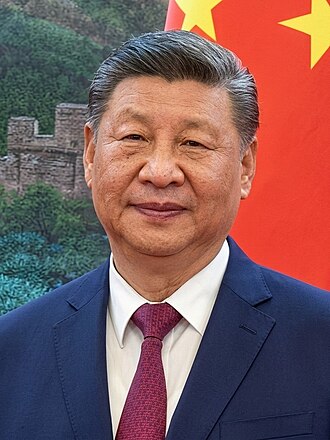
Xi Jinping

other
Xi Jinping is a Chinese statesman and politician who has served as the general secretary of the Chinese Communist Party (CCP) and chairman of the Party Central Military Commission (CMC) since 2012, and the president of China and chairman of the State Central Military Commission since 2013. Xi has been the leader of the fifth generation of Chinese leadership since 2012.
Standing...
Stories...
Jul 4, 2026
Lean Left
Held phone talks with US President Trump on bilateral ties and Korean Peninsula situation.
Praised for guiding stable superpower relations and expanding Belt and Road cooperation.
Jul 4, 2026
Far Left
Xi Jinping emphasized Taiwan as a core interest in a call with Trump, warning against reliance on US.
Praised for upholding China's core interests on Taiwan and maintaining strong leadership in diplomatic talks.
Jul 3, 2026
Lean Right
China pushes for Myitsone dam revival and expands party-state intelligence system (articles 4, 7).
His leadership centralizes state control, discouraging foreign investment and market freedoms.
Jul 3, 2026
Lean Left
Xi discussed bilateral ties and the Korean Peninsula with President Trump over the phone, and held talks with Serbian President Nikolic.
Praised for maintaining stable U.S.-China relations and advancing Belt and Road cooperation.
Jul 3, 2026
Far Right
Xi's regime is the central target of censorship protests highlighted in the Cloudflare report on attacks against civil society.
Pro-reform critics blame Xi for orchestrating the internet crackdown and repressive policies that stifle dissent.
Jul 3, 2026
Lean Right
Articles 5 and 9 highlight his role in China-US nuclear and China-Russia ties.
Market liberals fear his partnership with Putin threatens global stability.
Jul 3, 2026
Lean Left
Held phone call with President Trump and talks with Serbian President Nikolic.
CCP Mainstream celebrates Xi's diplomatic leadership in managing US ties and expanding BRI partnerships.
Jul 3, 2026
Far Left
Xi-Trump call stressed Taiwan as core interest, reaffirming China's sovereign position.
Praised for steadfast defense of national unity and territorial integrity.
Jul 2, 2026
Far Right
Drives policies on internet censorship, territorial claims in the South China Sea, and military modernization.
Pro-reform critics see Xi's tightening of control over information and aggressive territorial moves as undermining freedoms and raising conflict risks.
Jul 2, 2026
Lean Right
Signed the Ethnic Unity Law that effectively criminalizes Taiwanese identity and escalates cross-strait tensions.
Criticized for escalating authoritarian control and undermining the principle of 'one country, two systems' through coercive legislation.