
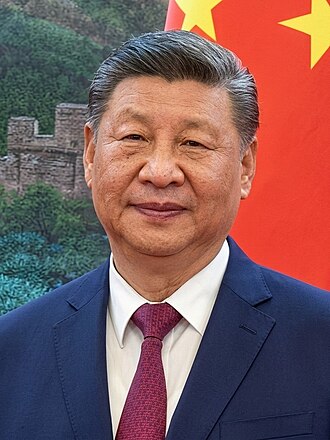
Xi Jinping

other
Xi Jinping is a Chinese statesman and politician who has served as the general secretary of the Chinese Communist Party (CCP) and chairman of the Party Central Military Commission (CMC) since 2012, and the president of China and chairman of the State Central Military Commission since 2013. Xi has been the leader of the fifth generation of Chinese leadership since 2012.
Standing...
Stories...
Sep 28, 2026
Far Left
Xi's call with Trump reaffirmed Taiwan as the core of core interests, with experts saying the space for relying on the US for independence will only shrink.
Party-line coverage treats Xi's Taiwan framing as a decisive strategic signal that Washington must respect, not a bargaining chip.
Sep 28, 2026
Far Left
China and the US agreed to reduce tariffs on $30 billion in products and start dialogue on artificial intelligence after Xi's visit to Washington.
Morena sees Xi's diplomatic engagement with the US as a counterbalance to Trump's aggressive posture, and a reminder that Mexico must navigate great power rivalry with its own sovereign interests.
Sep 28, 2026
Center
He met with Donald Trump this week, as shown in France 24's week-in-pictures roundup.
Renaissance monitors Xi's diplomatic engagement with Trump closely; France must ensure Europe is not sidelined in US-China negotiations that affect trade and security.
Sep 28, 2026
Center
Trump hosted Xi for a state visit, a major geopolitical moment that shapes Canada's trade and security calculus.
Centre voters are watching whether warmer U.S. China ties ease or complicate Canada's own relationship with Beijing, especially on trade and human rights.
Sep 28, 2026
Far Left
His state visit to Washington last week is still reverberating, with the US envoy to Beijing saying Taiwan policy is unchanged.
The far left is split between anti-imperialists who see any US-China tension as a prelude to war and left internationalists who refuse to defend a capitalist authoritarian state.
Sep 28, 2026
Center
Xi's state visit with Trump included a National Archives tour and a state dinner, but the key moment was Trump's social media media ban announcement.
Centrists are frustrated that a major-power diplomatic visit was subsumed by Trump's press feud, signaling unpredictable and unserious foreign policy management.
Sep 27, 2026
Far Right
Xi is in Washington for a state visit with President Trump, drawing rare protocol and protests from Uyghur and Tibetan advocates.
Pro-reform critics see Xi's visit as a charm offensive that whitewashes genocide and repression, while his government issues 'red lines' warning against human rights talks.
Sep 27, 2026
Far Right
Xi arrived in the US for a state dinner with America's top AI executives just days after Trump's Greenland deal undercut Beijing's Arctic influence.
Seen as the head of the globalist adversary whose economic and technological reach the Far Right wants systematically contained, not courted by corporate America.
Sep 27, 2026
Lean Right
Xi's state visit to Washington drew extensive official Chinese media coverage but almost no measurable public engagement, alongside mass protests outside the summit.
Market liberals criticize Xi for presiding over a closed, opaque political system that suppresses independent opinion, treats diplomacy as theater, and expands state-directed space infrastructure in the Global South.
Sep 27, 2026
Center
Xi's visit to the US produced agreements on AI, tariffs, and fentanyl precursor controls, with first lady Peng Liyuan also drawing attention for soft-power diplomacy.
Pragmatists see the summit as a stabilizing move that reduces geopolitical uncertainty, though skeptics question whether fentanyl and tariff pledges will be enforced.