
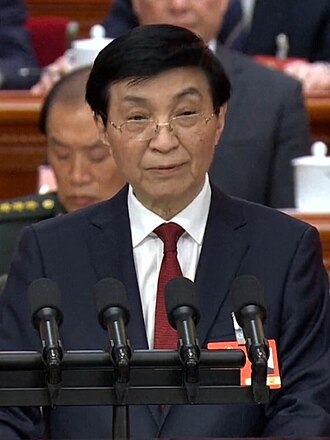
Wang Huning

Wang Huning is a Chinese political scientist and politician who is one of the top leaders of the Chinese Communist Party (CCP). He is currently the chairman of the National Committee of the Chinese People's Political Consultative Conference (CPPCC). He has been a leading ideologist in the country since the 1980s. He has been a member of the CCP's Politburo Standing Committee, the highest decision-making body within the party between convocations of the Central Committee and the National Congress, since 2017 (19th).
Standing...
Stories...
Aug 28, 2026
Far Left
CPC Central Committee member present at congratulatory message to Winter Olympics delegation, underscoring Party leadership in sports achievements.
Representing the Party's unified direction, his involvement symbolizes pride in national athletic success and soft power projection.
Aug 6, 2026
Far Right
Wang Huning, as the CCP's ideology chief, shapes the party's cultural censorship agenda behind policies like the Hunan Library ban and platform deletion sprees.
Pro-reform critics highlight him as the intellectual force normalizing stricter thought control and ideological policing.
Jul 29, 2026
Far Right
Wang Huning, a top ideologue, is associated with the design and promotion of the new 'ethnic unity and progress promotion' law that has extraterritorial reach.
Pro-reform critics see the law as a tool to suppress ethnic minority dissent at home and abroad, tightening control over diaspora communities.
Jul 23, 2026
Far Right
CCP ideologue believed to be the architect of thought guidance campaigns that underpin crackdowns like the Hong Kong bookstore raids.
Pro-reformers identify him as a key figure behind ideological repression and the narrowing of civil space.
Jul 15, 2026
Center
China's fourth-ranked official is leading a party and government delegation to North Korea for an official goodwill visit.
Pragmatists view this mission as a strategic effort to stabilize China's northern border and manage tensions with the US through a show of influence over Pyongyang.
Jun 12, 2026
Far Right
As the CCP's chief ideologist and the architect of campaigns against 'hostile foreign forces,' Wang's fingerprints are on the Ministry of State Security's widely mocked claim that foreign influence is driving youth slackerism in China.
Pro-reform commentators see Wang's ideological framework as intellectually bankrupt, using the foreign-interference bogeyman to deflect from real structural failures including youth unemployment and economic stagnation that are fueling disengagement.