
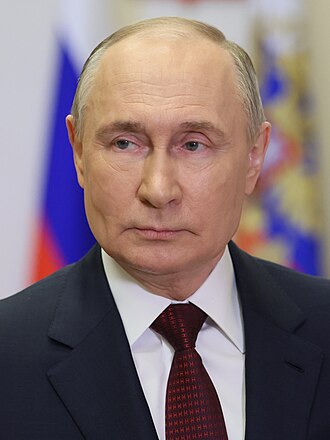
Vladimir Putin

other
Vladimir Vladimirovich Putin is a Russian politician and former intelligence officer who has served as President of Russia since 2012, having previously served from 2000 to 2008. Putin also served as Prime Minister of Russia from 1999 to 2000 and again from 2008 to 2012. He has been described as the de facto leader of Russia since 2000.
Standing...
Stories...
Aug 28, 2026
Center
CIA warnings against escalation in Ukraine appear unlikely to deter him, echoing pre-2022 invasion dynamics.
Centrists see this as a failure of deterrence and worry about unchecked aggression undermining global stability.
Aug 28, 2026
Far Left
Kremlin threatens to hit UK military targets inside and outside Ukraine over missile technology supply.
Putin's escalating nuclear rhetoric is a direct threat to UK security, but the Green Left insists that NATO expansion and arms supplies are provoking this escalation, demanding diplomacy over hawkishness.
Aug 26, 2026
Lean Right
Putin signed a decree allowing state control of critical infrastructure after Ukrainian drone strikes, signaling Russia's growing wartime strain.
The right views this as evidence of Russian weakness and a vindication of hawkish policies, while some warn against overextending US involvement.
Aug 25, 2026
Far Left
Russia amps up warnings as Burnham visits Ukraine, and a Russian AI-guided drone kills three Ukrainians, showcasing new autonomous weapons.
The far left is split: some see Putin as an imperialist aggressor, others see him as a convenient bogeyman used to justify NATO expansion and domestic repression; the AI drone story raises dystopian fears of unaccountable warfare.
Aug 22, 2026
Far Left
Russia's president, absorbing Ukraine's refinery strike and continued economic pressure from sanctions and war.
For many far leftists, Putin remains an authoritarian imperialist, but his regime's resistance to Western sanctions complicates simple good vs. evil framing, fueling internal splits.
Aug 22, 2026
Center
Ukraine's strikes on a major oil refinery deepen economic pressure on Russia's war machine.
Centrists support measured escalation that degrades Russian capacity, but worry about escalation and energy price spikes.
Aug 21, 2026
Lean Right
His visit to a disputed island exacerbates Japan-Russia tensions; also faked missile warnings to New Zealand.
Market Liberals view Putin's provocations as destabilizing for regional security and economic cooperation, raising risk premiums.
Aug 20, 2026
Center
Putin hosted Saddam Hifter, strengthening Russia's role in Libya's eastern camp.
Pragmatists see Russia as a complicating factor in the Middle East, but also a potential counterbalance to US pressure on Iran, though trust is minimal.
Aug 19, 2026
Center
Putin's visit to a disputed Kuril island is pushing Japan to consider tougher measures, including possible sanctions or recalling its ambassador.
Pragmatists note this as a deliberate provocation that could further alienate Japan, potentially driving it closer to Ukraine and the US-led coalition.
Aug 19, 2026
Lean Left
Russians are withdrawing billions from banks over fears Putin will seize deposits to fund his stalled invasion, according to analysts.
For Labour, this highlights how authoritarian aggression abroad feeds instability and energy price volatility at home, reinforcing the case for faster renewables.