Ursula von der Leyen

Germany
Christian Democratic Union
President of the European Commission
government
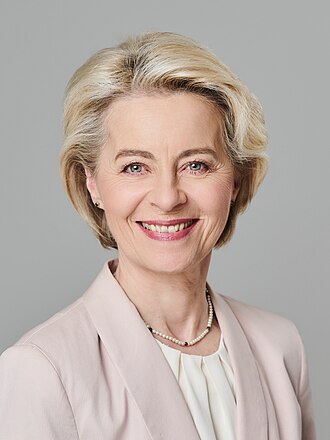
Ursula Gertrud von der Leyen is a German politician and physician who has served as President of the European Commission since 2019. She served in the German federal government between 2005 and 2019, holding positions in Angela Merkel's cabinet, most recently as Federal Minister for Defence. She is a member of the centre-right Christian Democratic Union (CDU) and its affiliated European political party, the European People's Party (EPP). On 7 March 2024, the EPP elected her as its Spitzenkandidat to lead the campaign for the 2024 European Parliament elections. She was re-elected to head the Commission in July 2024.
Standing...
Stories...
Sep 27, 2026
Center
The European Commission president warned of a 'second China shock' as Chinese tech firms face backlash risk in Southeast Asia.
Pragmatists view von der Leyen's warning as a real risk signal: China's export success could trigger protectionist responses if local partners feel hollowed out.
Sep 27, 2026
Far Left
L'Humanite reported that the European Green Deal's ambition is collapsing, with von der Leyen's state of the union speech unable to hide internal retreat.
LFI sees her as the liberal architect of a green transition that sacrifices social justice and now capitulates to agricultural and industrial lobbies, proving EU climate policy is not serious.
Sep 20, 2026
Center
The European Commission President proposed joint EU defense projects and is mentioned in the context of Macron's visit amid US tensions.
Renaissance supports von der Leyen's push for European strategic autonomy, viewing her as a key ally in reducing dependence on the US and countering Russian threats.
Sep 19, 2026
Far Left
She revived the idea of a European Security Council in her State of the Union speech, described as competing with the UN and modeled on NATO.
LFI criticizes von der Leyen for pushing militarization and a vague 'hybrid war' concept that serves to justify increased defense spending and erode sovereignty.
Sep 18, 2026
Far Right
The European Commission President opened the door to Canada becoming the EU's first associate member.
Peeople's Party backers view von der Leyen as a foreign bureaucrat meddling in Canadian affairs and pushing a supranational agenda.
Sep 18, 2026
Far Right
She proposed Canada as the EU's first 'associated member' and presented the 'Kids Act' to restrict social media access for children.
The RN views von der Leyen as a symbol of EU overreach, expanding the bloc's reach and meddling in national policies like online regulation.
Sep 18, 2026
Lean Right
Proposed that Canada become the EU's first 'associate member', prompting Trump's retaliatory threats and forcing Brussels into damage control.
LR reads this as the Commission president overreaching again, expanding the EU's geopolitical map without a mandate while imposing costly regulations like the methane rules on French motorists.
Sep 18, 2026
Center
The European Commission president floated the idea of Canada becoming the EU's first associate member in a speech without detailing what it would entail.
Renaissance broadly welcomes deepening ties with like-minded democracies like Canada, though it will want the Commission to clarify the substance rather than float vague headline ideas.
Sep 18, 2026
Center
European Commission President is driving Canada's EU associate membership and 'common prosperity' space, and plans AI safety talks with frontier labs.
Centrists see her as a constructive partner offering a credible alternative market, though some question whether associate membership delivers binding trade access or symbolic diplomacy.
Sep 18, 2026
Far Left
Carney referenced her call to move beyond CETA toward an EU-Canada alliance for sovereignty and independence.
The far left views von der Leyen as an architect of EU austerity and militarism, and any Canada-EU pact she brokers is likely to entrench neoliberal trade rules rather than protect workers.