
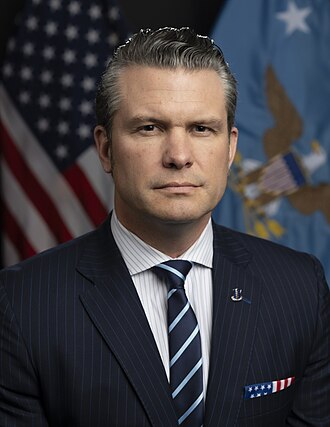
Pete Hegseth

United States
Republican
United States Secretary of Defense
government
Peter Brian Hegseth is an American government official and former television personality who has served since 2025 as the 29th United States secretary of defense.
Standing...
Stories...
Jul 23, 2026
Lean Left
Pete Hegseth, US Defence Secretary, was confronted by protesters who told him he has 'blood on his hands' at a hearing on Iran war.
Labour sympathises with the protesters and opposes a new war in Iran, seeing Hegseth as a hawkish figure.
Jul 23, 2026
Far Left
US Secretary of War stated the Iran offensive has cost $37.5 billion so far.
Criticized for escalating wasteful US militarism that diverts resources from social needs.
Jul 22, 2026
Lean Left
The US Secretary of Defense stated that Trump promised no more foolish wars and that the US is not trying to rebuild Iran, only preventing a nuclear bomb.
Moderates see Hegseth as articulating a limited war aim that still fails to address the ongoing conflict's human and regional costs.
Jul 22, 2026
Far Left
The US Secretary of Defense testified before the Senate that the war with Iran has cost $37.5 billion and acknowledged Iran's remaining military capabilities.
Reformists see Hegseth's admission as validation that hardline rhetoric has only escalated confrontation and incurred massive costs without neutralizing Iran's threat.
Jul 22, 2026
Center
Hegseth testified before the Senate requesting nearly $80 billion for Iran war replenishment, estimating total cost at $37.5 billion.
Centrists are critical of the war's open-ended cost and want clearer benchmarks for success and withdrawal.
Jul 22, 2026
Lean Left
Defense Secretary Hegseth testified that the Iran war has cost $37.5 billion and defended a $67 billion emergency funding request.
Hegseth is criticized by Democrats as a failure and an enabler of an unnecessary, expensive war with no exit strategy.
Jul 20, 2026
Far Left
Defense Secretary Hegseth announced a Pentagon program to boost testosterone among troops, which a Trump biographer called a stunt for his 2028 political ambitions.
Hegseth embodies the militarized masculinity and absurdity of Trumpism; the far left views the testosterone program as a clownish distraction from the ongoing bombing of Iran.
Jul 20, 2026
Center
Hegseth directed the military to test testosterone levels for troops over 30 as part of periodic health assessments.
Center/moderates are divided: some see it as a pragmatic readiness initiative, while others question the medical evidence and privacy implications, viewing it as a culture war distraction.
Jul 19, 2026
Far Right
Reacted to the death of US soldiers in Jordan, stating their sacrifice strengthens US determination.
RN appreciates Hegseth's tough rhetoric and sees him as a voice for American nationalism and military strength.
Jul 19, 2026
Far Left
US defense secretary ordered annual testosterone screening for soldiers aged 30 and older.
Criticized for pushing unscientific, militaristic health policies that pathologize normal aging and distract from real soldier welfare.