
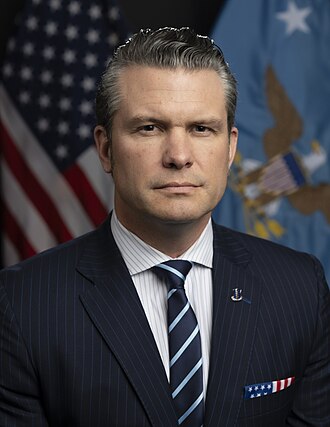
Pete Hegseth

United States
Republican
United States Secretary of Defense
government
Peter Brian Hegseth is an American government official, U.S. Army veteran, and former television personality who has been serving as the 29th United States secretary of defense since 2025.
Standing...
Stories...
Jun 7, 2026
Center
The US Defense Secretary attended D-Day commemorations in Normandy but was rejected by Langrune-sur-Mer residents and used the occasion to demand Europe fight migrant 'invasion', drawing sharp local backlash.
Renaissance centrists view Hegseth's weaponization of a solemn Allied memorial for Trump-era culture-war messaging as a serious diplomatic provocation, undermining the transatlantic relationship Macron has worked to preserve.
Jun 7, 2026
Lean Left
The US Secretary of Defense used D-Day commemorations in Normandy to compare immigration to a wartime invasion, drawing sharp condemnation.
Socialistes regard Hegseth's remarks as a deliberate desecration of anti-fascist memory, emblematic of the Trump administration's rhetorical alignment with European far-right movements including RN.
Jun 6, 2026
Lean Right
US Defense Secretary Hegseth delivered a closely watched speech at the Shangri-La Dialogue without mentioning Taiwan once, alarming regional partners.
Market liberals criticize Hegseth's omission as a dangerous signal of US unreliability: failing to deter Beijing on Taiwan weakens the credible commitment that underpins Indo-Pacific trade and security stability.
Jun 6, 2026
Lean Right
The US Secretary of Defense spoke at the American military cemetery in Colleville-sur-Mer, warning that European beaches are threatened by dangerous ideologies and pressing Europeans to do more for their own defence.
LR largely agrees with the substance of Hegseth's pressure on European defence burden-sharing, even if his rhetoric is blunt, as it aligns with the party's longstanding criticism that France and its neighbours have outsourced their security to Washington for too long.
Jun 6, 2026
Center
US Defence Secretary Pete Hegseth used the D-Day 82nd anniversary ceremony in France to demand Europe treat migration as a military-scale invasion and increase defence spending contributions.
Pragmatists will note Hegseth is repurposing a solemn Allied commemorative moment for domestic culture-war messaging, undermining the credibility of a genuine burden-sharing argument that has real strategic merit.
Jun 6, 2026
Center
The US Defence Secretary used a D-Day anniversary speech in Normandy to warn Europe of an 'invasion of dangerous ideologies' arriving by sea, explicitly linking immigration to the wartime legacy.
From a Lib Dem perspective, Hegseth's speech is a cynical and historically offensive distortion, weaponising the sacrifice of Allied soldiers to legitimise hard-right anti-immigration politics and straining the UK-US relationship.
Jun 6, 2026
Lean Left
US Defense Secretary Hegseth was publicly rejected by French villagers during his D-Day anniversary visit and warned European allies about dangerous ideologies, generating significant backlash.
Labour-leaning readers will see Hegseth's rejection by D-Day communities as symbolic of how Trump-era American nationalism has corroded the transatlantic alliances that underpin UK security, reinforcing arguments for a stronger European defence posture independent of Washington.
Jun 6, 2026
Center
Defense Secretary Hegseth delivered a D-Day commemoration speech in Normandy warning Europe about 'dangerous ideologies' linked to immigration, using a sacred military anniversary to advance a domestic culture-war argument.
Centrists broadly criticize repurposing D-Day, a moment of bipartisan reverence for sacrifice and democratic defense, as a vehicle for nativist messaging, seeing it as prioritizing political brand-building over diplomatic seriousness.
Jun 5, 2026
Lean Right
The US Defense Secretary delivered a closely watched speech at the Shangri-La Dialogue without mentioning Taiwan once, a conspicuous omission that alarmed regional allies.
Market liberals view Hegseth's Taiwan silence as a dangerous failure of deterrence signaling, raising the risk premium for businesses and investors operating across the Indo-Pacific and undermining confidence in US security commitments that backstop regional trade.