
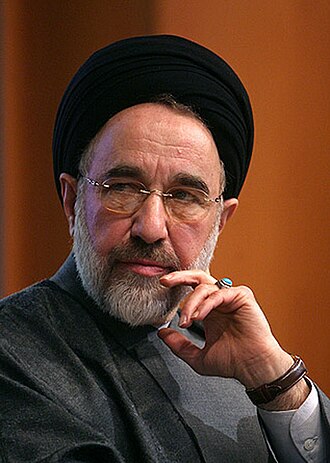
Mohammad Khatami
Mohammad Khatami is an Iranian reformist cleric who served as President of Iran from 1997 to
Standing...
Stories...
Oct 6, 2026
Far Left
Former reformist president's recent statement calling for free elections is circulating on social media.
Reformists praise Khatami for still advocating for democratic reforms despite years of house arrest and pressure, seeing him as a moral compass.
Oct 5, 2026
Lean Left
Not mentioned today, but as the leading reformist former president, his silence on the current energy and subsidy debates leaves a vacuum that moderates wish he would fill with calls for pragmatic governance.
Moderates still look to him as a moral voice, but his absence from pressing economic debates makes him increasingly irrelevant to the daily bread-and-butter politics.
Oct 3, 2026
Center
Not directly in today's articles, but his reformist legacy is a reference point for activists demanding more social and political space.
Pragmatists admire his attempt at dialogue and reform but criticize the failure to institutionalize change before hardliners reasserted control.
Sep 30, 2026
Far Right
Referred to indirectly in Kayhan's 'traitors' dossier and 'custom headline' piece attacking reformist media cover ups.
Principlists treat his faction as the domestic arm of Western soft war and demand accountability.
Sep 22, 2026
Far Left
Sent a condolence message on the death of Grand Ayatollah Shobeiri Zanjani.
Reformists view Khatami's gesture as a reminder of the reformist movement's religious legitimacy amid continued pressure.
Sep 19, 2026
Far Right
No mention, but his reformist legacy is implicitly criticized in calls for moral discipline.
Principlists blame Khatami's era for cultural laxity and align with Kayhan's warnings against Sufism and long hopes.
Sep 18, 2026
Far Right
Former Reformist president remains a symbolic figure for the Reformist camp that Principlists criticize.
Principlists view Khatami's legacy as a cautionary tale of Reformist accommodation with the West, and his continued influence is seen as a threat to ideological purity.
Sep 16, 2026
Lean Left
No direct mention in articles, but as a leading reformist, his legacy is often invoked. The current lack of reformist voices in the news highlights their marginalization.
Moderates look back at Khatami's era as a time of greater openness and reform, and they lament the current exclusion of reformist figures from meaningful political discourse under the current system.
Sep 16, 2026
Far Left
The former Reformist president has not commented on the hijab law letter, but his silence is notable given the scale of the clerical push.
Reformists look to Khatami as a moral compass and are disappointed he has not spoken out against the enforcement of the hijab law.
Sep 15, 2026
Far Right
The reformist former president is implicitly targeted by Kayhan's attack on reformists deceiving the 'village chief' at a time of global change.
Principlists view him as the symbol of the reformist faction that bets on America and undermines Iran's resistance posture.