
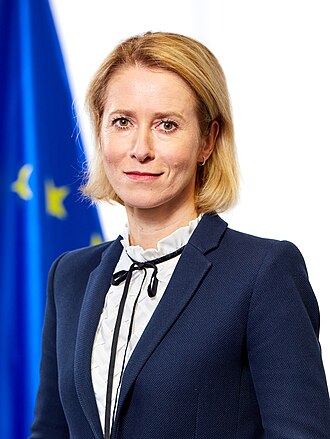
Kaja Kallas

Soviet Union
Estonian Reform
High Representative of the Union for Foreign Affairs and Security Policy
government
Kaja Kallas is an Estonian politician and diplomat. She was the first female prime minister of Estonia, a role she held from 2021 until 2024, when she resigned in advance of her appointment as High Representative of the European Union for Foreign Affairs and Security Policy. Since 2024, she has served in that role as well as Vice-President of the European Commission in the second von der Leyen Commission.
Standing...
Stories...
Sep 22, 2026
Center
The EU foreign policy chief said the Aspides naval mission in the Red Sea needs more than 10 warships but lacks them.
Pragmatists read this as proof Europe cannot secure key trade routes without US help, weakening its leverage in any Iran nuclear or regional talks.
Sep 22, 2026
Center
The EU's top diplomat urged member states to send more naval vessels to protect commercial shipping in the Red Sea against Houthi threats.
Moderates see this as a burden-sharing question: whether Europe will step up on shipping security or continue free-riding on US naval power.
Sep 15, 2026
Lean Left
EU foreign policy chief slammed Russian drone attack on Ukraine train station where dignitaries had gathered.
Liberals support Kallas's strong stance against Russia, viewing it as a reminder of the need for continued Western unity, which Canada backs.
Sep 12, 2026
Far Right
The EU foreign policy chief compared Judea and Samaria to Crimea and promoted an EU trade ban, drawing Sa'ar's sharp rebuke.
Religious Zionism views Kallas as the latest European official applying a double standard that treats Israeli communities in the heartland as illegally occupied territory.
Sep 12, 2026
Center
EU foreign policy chief Kaja Kallas said Israeli settlements should be treated like Crimea, prompting a sharp response from Sa'ar.
Yesh Atid views Kallas's comparison as hostile and unhelpful, but they also see it as a symptom of the Netanyahu government's failure to maintain Israel's international standing.
Aug 2, 2026
Lean Right
She is overseeing EU sanctions on Southeast Asia scam networks and a likely refresh of Europe's China policy.
Market liberals support targeted sanctions against economic enablers but want the EU to keep human rights central to its China engagement rather than an afterthought.
Aug 1, 2026
Center
The EU’s foreign affairs chief is expected to visit Beijing this autumn amid strained EU-China relations.
Her trip highlights Europe’s balancing act, seeking to counter China’s economic coercion while avoiding full alignment with US decoupling efforts.
Jul 23, 2026
Far Left
EU foreign policy chief announced the largest round of sanctions against Russia in four years.
Praised by Greens/Radical Left for strong action against Putin, though some criticize arms trade and militarism in Ukraine.
Jul 9, 2026
Lean Right
The EU foreign policy chief stated that recent exchanges of fire between the US and Iran in the Middle East complicate ongoing negotiations to end the conflict.
Conservatives view her statement as evidence of EU bias against Iran and a failure to acknowledge US aggression, reinforcing distrust of European mediation.
Jun 30, 2026
Lean Left
The EU foreign policy chief denied plans for a separate European army, emphasizing NATO's role and Turkey's importance in European security.
Moderates consider her statement a reassurance that Europe remains reliant on NATO, reducing the risk of new military blocs.