
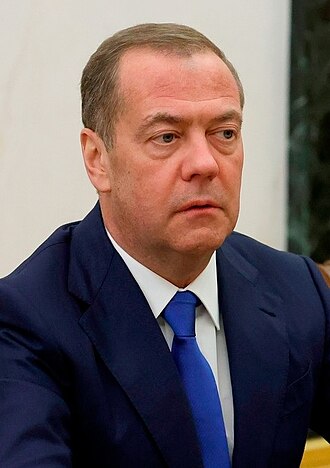
Dmitry Medvedev

other
Dmitry Anatolyevich Medvedev is a Russian politician and lawyer who served as the president of Russia from 2008 to 2012 and as prime minister of Russia from 2012 to 2020. As of 2020, he has served as the deputy chairman of the Security Council of Russia.
Standing...
Stories...
Oct 21, 2026
Center
The Russian Security Council deputy chairman said Russia and the US will remain structural enemies despite temporary considerations.
Pragmatists view his comments as a reminder of the geopolitical constraints Iran faces, but also as an opportunity for Iran to play off rivalries.
Oct 12, 2026
Far Left
He warned against relying on Trump's positions on Zelensky, saying Russia's victory depends on military capability.
Reformists read Medvedev's statement as a sign that Moscow is hedging its bets and will not act as a reliable shield for Iran against US pressure, deepening their sense of isolation.
Oct 5, 2026
Lean Left
Putin's henchman revealed a horror list of areas Russia 'must control' before peace in Ukraine.
Labour will cite Medvedev's demands as proof that Putin cannot be trusted and that the UK must maintain a tough stance on Russia.
Oct 4, 2026
Center
The Russian Security Council deputy chairman said Iran continues normal life during wartime and Russia will never sacrifice its ties with the Islamic Republic.
Pragmatists read this as Moscow locking in its strategic partnership with Tehran at a moment when Washington is signalling possible de-escalation, which complicates Iran's room for manoeuvre.
Sep 11, 2026
Far Left
Russian Security Council deputy chair said Moscow could reduce Kyiv and NATO facilities to 'gray nuclear dust' and insists Russia sets the terms for ending the war.
Reformists view Medvedev's nuclear saber-rattling as a direct threat multiplier for Iran, reinforcing their argument that alignment with Moscow deepens Iran's international isolation.
Aug 30, 2026
Lean Right
Russian media discourse uses 'Latin poison' to attack Kazakhstan's Latinization, reflecting Moscow's geopolitical aims.
Market liberals see this as part of Russia's effort to dominate post-Soviet states, hindering their integration with global markets.
Aug 30, 2026
Far Left
Russia's Security Council deputy chair dismissed US claims of Iran's defeat as a mirage, reaffirming Moscow's support.
Reformists welcome this external validation of Iran's resilience, as it bolsters their narrative that the war's outcome was not a humiliation.
Aug 29, 2026
Center
Russian Security Council deputy chair called US policies 'dictatorship' and said claims of Iran's defeat are false.
Pragmatists view such statements as convenient alignment but not a substitute for real economic partnership.
Jul 2, 2026
Far Left
The former Russian president and prime minister is arriving in Tehran as Putin's special envoy to attend the funeral of the late Supreme Leader.
Reformists view Russia's high-level presence as a sign of strategic solidarity, but are cautious about over-reliance on Moscow while seeking to balance ties with the West.
Jun 26, 2026
Far Left
Medvedev criticized Western sanctions against Iran, Russia, China, and North Korea as unilateral and illegal.
Reformists welcome Russia's support but recognize it as rhetorical; real relief depends on the US deal.