
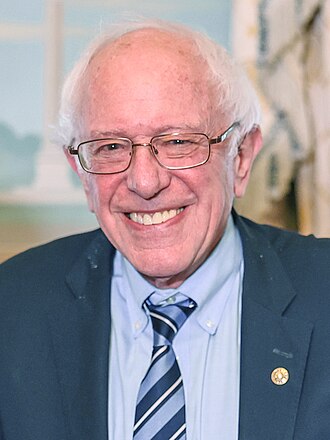
Bernie Sanders

United States
independent politician
United States senator
government
Bernard Sanders is an American politician and activist serving as the senior United States senator from Vermont, a seat he has held since 2007. He is the longest-serving independent in U.S. congressional history, but maintains a close relationship with the Democratic Party, having caucused with House and Senate Democrats for most of his congressional career and sought the party's presidential nomination in 2016 and 2020. Ideologically a democratic socialist, Sanders is regarded as one of the main leaders of the 21st-century American progressive movement.
Standing...
Stories...
Oct 15, 2026
Far Left
La Jornada's editorial cites his denunciation of billionaire spending in U.S. elections and his call to reform campaign finance.
Morena uses Sanders to argue that U.S. democracy is a plutocracy, reinforcing the 4T critique of neoliberal power.
Oct 9, 2026
Far Left
Not directly mentioned in the articles, but the 2020 primary betrayal remains the defining wound for the youngest left cohort as Democrats surge toward a possible blue wave.
Sanders is the ghost at the feast: the left is watching the same party institutions that coordinated against him in 2020 prepare to absorb anti-Trump energy, and his absence from the midterm narrative proves the establishment won.
Oct 4, 2026
Lean Left
Sanders is rallying in California in support of a ballot initiative that would place a one-time 5% tax on billionaires in the state.
The left sees Sanders as the tip of the spear on wealth taxation, and this fight is a test of whether the party can be pushed toward taxing billionaires rather than protecting them.
Sep 28, 2026
Far Left
He is not in today's headlines, but the far left's ongoing electoral-versus-movement debate revolves around his two presidential campaigns and their aftermath.
The far left remains divided on whether Sanders built anything durable or merely channeled radical energy into a party that crushed it, a tension that shapes every strategic argument today.
Sep 24, 2026
Far Left
The US senator called for ending Trump's war against Iran and halting arms transfers to Israel.
Reformists cite his stance as evidence that American opposition to Trump's Iran policy is real, reinforcing their argument that negotiation, not escalation, is the winning path.
Sep 23, 2026
Far Left
Sanders and Steve Bannon both spoke before a Washington group demanding a stop to AI and its datacenters, as Robert Reich noted in a Guardian column.
The left sees Sanders's anti-AI populism as a rare attempt to challenge corporate power over technology, even as it worries about the strange-bedfellows optics of aligning with Bannon.
Sep 21, 2026
Far Left
Not directly in today's articles, but his 2016 and 2020 campaigns remain a reference point for left electoral strategy.
Far left sees Sanders as both a galvanizing figure and a cautionary tale of how party institutions crush left insurgencies; his continued role is debated.
Sep 20, 2026
Lean Right
His appearance at the same AI conference with Bannon reflects a bipartisan push for AI oversight in the Senate.
The right is suspicious of Sanders' motives, seeing a socialist using AI fear to smuggle in central planning, but acknowledges the strange-bedfellows moment reveals how much the bipartisan establishment fears losing control of the technology.
Sep 18, 2026
Far Right
He is leading opposition to Trump's proposed $2.8 billion Israeli bomb transfer.
Sanders is an unlikely ally for the anti-interventionist right, but his opposition to the bomb transfer highlights the growing divide within the GOP on Israel.
Sep 16, 2026
Center
Sanders and Steve Bannon jointly called for restrictions on AI systems at a Washington gathering, uniting political adversaries around concerns about the technology harming humans.
Pragmatists note that Sanders and Bannon agreeing on AI limits shows how public unease is cutting across ideological lines, but they question whether Congress can pass meaningful regulation without stifling US competitiveness against China.