
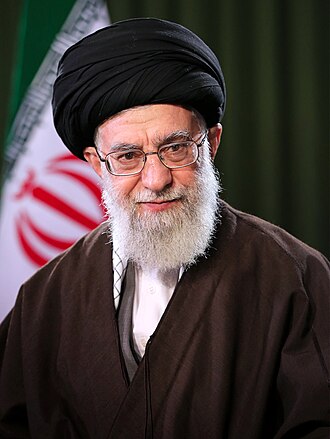
Ayatollah Seyyed Ali Khamenei

Pahlavi Iran
Combatant Clergy Association
commanding officer
government
Ali Hosseini Khamenei was an Iranian politician and Shia cleric who served as the supreme leader of Iran from 1989 until his assassination by Israeli airstrikes in 2026. The patriarch of the Khamenei family prior to his death, Khameini had previously served as the president of Iran from 1981 to 1989. His 36-year tenure makes him Iran's longest-serving supreme leader.
Standing...
Stories...
Oct 7, 2026
Far Right
He is implicitly invoked in articles on velayat-madari and the Islamic Republic's constitutional framework.
Principlists treat his authority as the anchor of the system and the ultimate arbiter of all political and strategic matters.
Jul 12, 2026
Far Right
The martyred Supreme Leader whose funeral processions drew record crowds and emotional outpourings.
He is the ultimate symbol of Principlist resistance; his martyrdom solidifies the narrative of American treachery and holy revenge.
Jul 11, 2026
Lean Right
The martyred Supreme Leader's funeral saw massive turnout across Iran, with millions participating in processions.
From a conservative perspective, his assassination has become a source of unity and resolve, proving the resilience of the Islamic system.
Jul 10, 2026
Far Right
Flags reading 'Ya Latharat al-Khamenei' were raised at the funeral of Imam Shahid in Iraq, linking the martyr to the Supreme Leader.
Principlists view this as a reaffirmation of loyalty to the Leader and the axis of resistance, strengthening his position as the guiding authority.
Jul 10, 2026
Lean Right
The martyred Supreme Leader's funeral and burial are the central event of the day, with millions participating in Mashhad.
Conservatives revere him as the ultimate symbol of Islamic resistance and martyrdom, and his death galvanizes the base to continue his legacy of defiance against the West.
Jul 10, 2026
Lean Left
The martyred Supreme Leader's funeral is being held in Mashhad and Iraq, with massive public participation and international coverage.
Moderates view his passing as a historic moment of national unity but also uncertainty about succession and policy continuity.
Jul 9, 2026
Lean Right
His remains and family members' remains were transferred from Najaf to Karbala for final farewell, with massive processions across Iraq and Iran.
Conservatives revere him as the ultimate symbol of resistance and martyrdom, and his death is seen as a rallying point that strengthens the Islamic system and the Axis of Resistance.
Jul 6, 2026
Lean Right
His martyrdom and funeral ceremonies dominate the news as the nation mourns the Supreme Leader.
Conservatives revere him as the ultimate guardian of the revolution and a martyr, and his loss strengthens their commitment to his hardline legacy.
Jun 17, 2026
Far Right
Supreme Leader's Friday sermon stressed no compromise on nuclear rights and denounced reformists' engagement policy.
Principlists see his leadership as the anchor of the Islamic Revolution, opposing any deviation toward Western appeasement.
Jun 17, 2026
Lean Right
Referenced in 'bay'at' ceremonies during the 108th night of mourning, symbolizing popular allegiance to his leadership.
Conservatives praise his role as the axis of national unity and the embodiment of Wilayat al-Faqih, which is the foundation of their ideological identity.